2026 update · October 2026
The core advice still holds: sell where your buyers are, and run every channel from one view of orders and stock. The market figures and some of the marketplaces named in the original are out of date. Vinculum, the vendor it mentions, now lists its order system as Vin OMS.
U.S. Census Bureau figures show e-commerce made up 17.1 percent of U.S. retail sales in the second quarter of 2026. The growth figures in the original are from 2017.
Souq is now Amazon: Amazon.ae from 2019, then Saudi Arabia in 2020 and Egypt in 2021. Rakuten closed its U.S. marketplace in 2020. Check which marketplaces your buyers use today.
Store platforms now link to marketplaces themselves. Shopify Marketplace Connect, for example, syncs listings, orders and stock with Amazon, eBay, Walmart and Target Plus.
Amazon Multi-Channel Fulfillment ships orders from other channels out of one pool of stock. In 2025 Amazon added direct support for Shopify and Walmart Marketplace orders.
We build stores on Shopify, Shopify Plus, BigCommerce, WooCommerce, Magento, Ecwid and OpenCart, and a new website takes 6 to 10 weeks. See our e-commerce development service.
Original article · 2017
Written in 2017 and kept as written. Market figures, marketplaces and vendor details are from then; see the update above for what has changed.
Though ecommerce is a fraction of overall retail sales, it has clearly been outpacing brick and mortar sales year over year for some time now. The National Retail Federation predicts that non-store sales will grow 8-12% in 2017, compared with a projected 3.7-4.2% growth rate for the retail industry as a whole. Globally, it is a USD $19 billion opportunity. This presents an opportunity for retailers of all sizes to reach customers who are not necessarily in the same geographical area where the retailer operates. Cross-border commerce is a significant opportunity for retailers to tap into. Forrester estimates the size of the cross-border online retail market to be in excess of $1 trillion and it is growing at an annual rate in excess of 20%. Just China by itself accounts for USD $997 billion, regions in Southeast Asia are growing at a rate of 16% cumulative annual growth (CAGR), with India growing at 75% and the Middle East growing at 45%. The opportunity is significant for SMBs and brands alike since cross-border presents a major revenue opportunity and by providing unique products and great customer service, they can tap into the entire world as a market.
There are a number of strategies that brands and SMBs can adopt to reach its customer:
These strategies involve complexities outlined below that have to be addressed for a smooth operation:
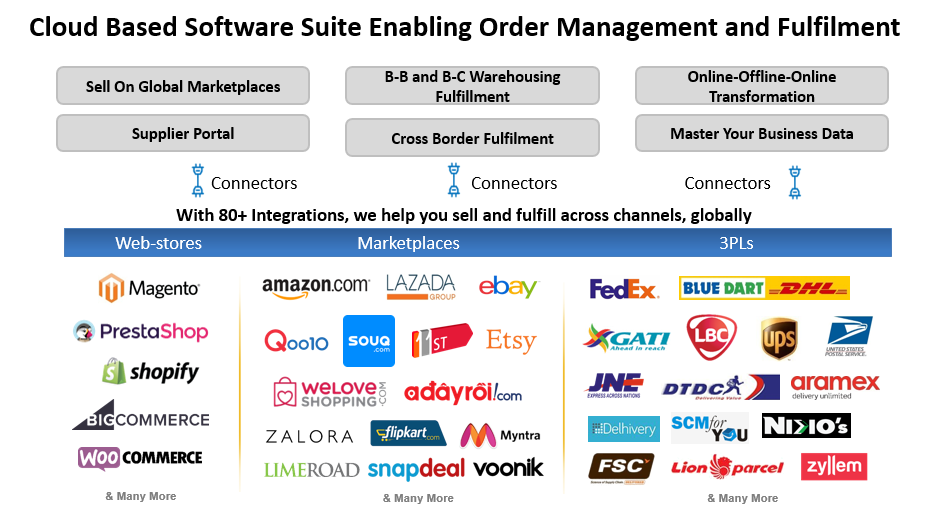
Online businesses or businesses going online can reap the benefits of such operational optimizations, insights and automation by utilizing a specialized order management system (OMS) like Vin eRetail that provides SMBs the ability to sell on multiple marketplaces domestically and also reach international customers through cross border marketplaces. With ready integrations to 3PLs and marketplaces globally, such a platform can help you to manage orders and inventory from a simple dashboard, track and trace information to customers and provide you with real-time inventory updates to all channels. Schematically, it would be something like :
To learn more about how Vin eRetail can help grow your business with a Cloud Based Order Management & Fulfillment system, we welcome you to reach out to [email protected]. To learn more about building and marketing an ecommerce store, JLB USAis here to help.
Talk to usRequest a Technology Health Assessment
Or call 954-539-5678